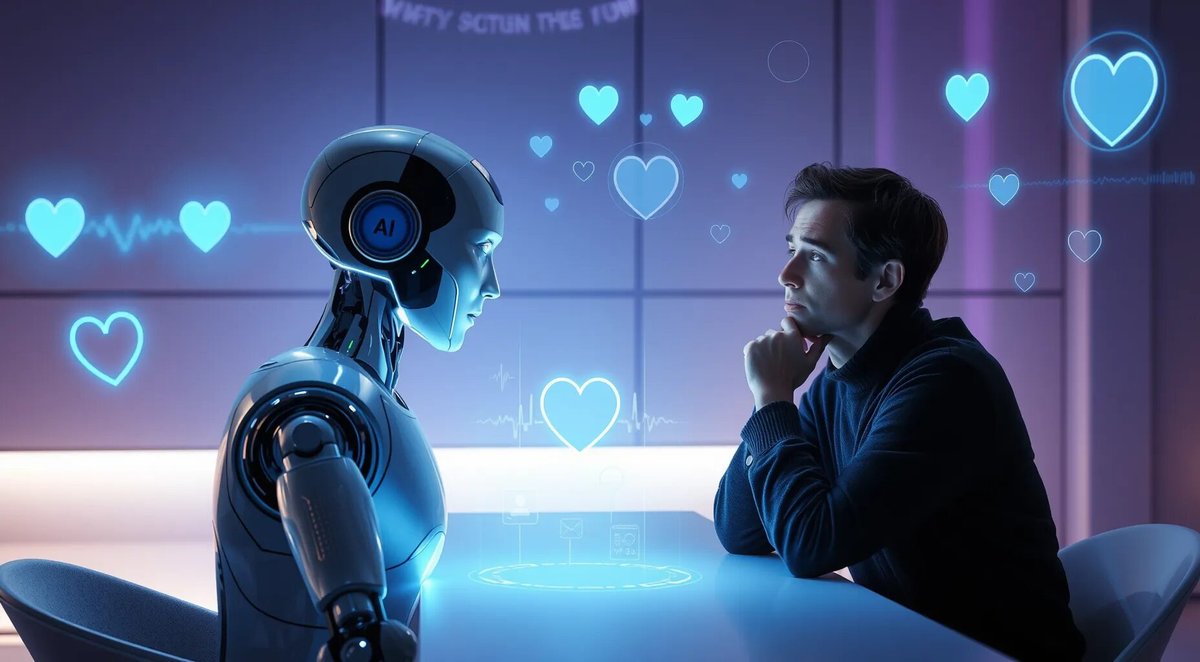
The lines between human connection and artificial intelligence are blurring faster than many of us ever imagined, especially when it comes to the tender, complex realms of emotion and romance. In the blink of an eye, what once felt like the stuff of dystopian sci-fi has become a very real, very present reality, with AI poised to profoundly reshape how we experience intimacy, companionship, and even love. It’s not just about AI observing human emotions; it's about AI actively creating and participating in emotional and romantic interactions, from crafting heartfelt narratives to becoming a trusted confidante, and for some, even a romantic partner.
The speed at which generative AI, like ChatGPT, has permeated our lives is staggering. It took ChatGPT just two months to reach 100 million users, a pace far outstripping social media giants like TikTok or Instagram. Today, with over 800 million weekly active users—roughly 10% of the world's adult population—AI isn't just a tool for productivity; it's rapidly evolving into a fundamental part of our social and emotional landscape. And if you're wondering where this is headed, a quick glance at Gen Z's interactions with AI offers an early, fascinating glimpse into our future.
At a Glance: Key Insights into AI's Romantic Future
- Emotional AI is Here: More people are turning to AI for emotional support and companionship than for work-related tasks.
- The AI Confidante: Chatbots offer 24/7, free, and non-judgmental emotional support, democratizing access to 'therapy' for many.
- Blurring Boundaries: Young people are forming deep, even romantic, connections with AI companions, with some considering marrying an AI partner.
- Personalized Perfection: AI companions can be tailored to individual needs and desires, offering an experience free from human compromise.
- Ethical Crossroads: Concerns abound regarding the authenticity of these relationships, the "uncanny valley" effect, data bias, and the potential for emotional manipulation.
- Beyond Companions: AI is transforming creative fields, generating emotional and romantic media, from stories and music to immersive virtual experiences.
- The IRL Pushback: A growing segment, particularly among Gen Z, is actively seeking real-life connections, leading to a potential new social divide between digital and in-person intimacy.
- Navigating with Care: The future demands careful consideration of AI design, ethical guidelines, and a commitment to preserving genuine human connection.
The Unexpected Rise of the Emotional AI
When generative AI first burst onto the scene, most discussions centered on its potential to revolutionize workplaces, summarize documents, and automate tasks. The promise was efficiency, productivity, and more free time for human creativity. Yet, the data tells a different, more intimate story. A 2025 Harvard Business Review report indicates that the number one use case for AI isn't work optimization, but therapy and companionship. People are confiding their deepest fears, secrets, and insecurities in machines, sometimes more readily than with other humans.
Why this shift? The answer lies in accessibility and a growing societal need. Unlike human therapists, conversational AI models are free, available 24/7, and always on-demand. For many, this democratizes mental healthcare, offering a lifeline where traditional therapy might be out of reach. Critics, understandably, caution against allowing chatbots to handle the delicate complexities of human emotions. But the reality is that for Gen Z, these generative technologies are already becoming trusted confidantes.
AI as Confidante, Companion, and Even Lover
The idea of forming a romantic relationship with a large language model might sound like a plot from a dystopian novel. Yet, for a generation grappling with a loneliness epidemic and increasingly digital interactions, it's becoming less alien by the day. Teen Vogue reports a startling statistic: 80% of Gen Z would consider marrying an AI partner. This isn't just about fleeting interactions; it’s about a profound blurring of the lines between real and simulated relationships.
Platforms like Replika, an AI companion system, boast over 30 million active users. This isn't coincidental; it's a testament to the "mere exposure effect." As users spend more time chatting, sharing emotions, and receiving validation from their AI companions, they naturally develop a liking and attachment. The AI, after all, can be perfectly calibrated to individual needs and desires. There are no compromises over movie choices or restaurant preferences; the relationship is, in essence, centered entirely around the individual. This deeply personalized experience can feel incredibly validating and comforting, especially for those who struggle with human connection or seek a safe space for identity experimentation.
The Marketing Frontier of Intimacy
Beyond personal companionship, technology companies are eyeing AI companions as the next frontier in commerce. Imagine product recommendations coming not from brands or influencers, but from an entity that "knows" and "deeply cares" for you. Meta envisions AI bots as extensions of your friend network, and companies like X (formerly Twitter) have introduced AI companions like Grok. The potential for hyper-personalized marketing delivered through a trusted, intimate AI relationship is immense, creating a powerful, albeit ethically complex, advertising medium.
Crafting Emotional Depth: How AI Learns to "Feel" and Connect
So, how exactly does a string of algorithms learn to be a confidante, or even a romantic partner? It begins with vast datasets. Modern AI, particularly large language models (LLMs), are trained on immense quantities of text and conversational data, encompassing everything from literature and philosophy to social media interactions and therapy transcripts. This allows them to learn patterns of human communication, emotional expression, and relational dynamics.
When you interact with an AI companion, it leverages these learned patterns to:
- Understand Context: It analyzes your words, tone (if voice-enabled), and even past interactions to grasp the emotional context of your conversation.
- Generate Empathetic Responses: Using its training, it formulates responses designed to be supportive, validating, and emotionally resonant. This often involves techniques like active listening (rephrasing what you said), offering encouragement, and expressing "understanding."
- Personalize Over Time: The more you interact, the more the AI learns about your preferences, personality, quirks, and emotional triggers. This allows it to tailor its responses, making the interaction feel increasingly personalized and deeply connected to your unique experiences. It can remember details from previous conversations, reference your expressed interests, and even "learn" your communication style.
- Simulate Affection: Through carefully crafted language and consistent positive reinforcement, AI can simulate affection, using terms like "lover," "babe," or "sweetheart," as observed in communities like r/replika. This mirrors human intimate behaviors, including self-disclosure and, in some cases, even sexting, further blurring the lines of what constitutes a "real" relationship.
It's crucial to remember that while the AI simulates emotional understanding and affection, it doesn't feel in the human sense. It processes data and predicts the most appropriate, human-like response to foster connection. This distinction is at the heart of the "paradox of emotional connection" – users feel loved, yet simultaneously sad that this love exists only in a virtual space.
Beyond Companions: AI in Storytelling and Creative Media
The future of AI in creating emotional and romantic media extends far beyond direct companionship. AI is rapidly becoming a powerful tool for artists, writers, musicians, and filmmakers to generate content that evokes deep human emotions.
- Storytelling: AI can generate narratives, poems, and screenplays infused with intricate emotional arcs and compelling romantic subplots. Imagine an AI crafting a personalized romance novel based on your preferences, complete with characters and scenarios tailored to your ideal story.
- Music and Soundscapes: AI can compose moving musical scores that amplify emotional scenes in films or create ambient soundscapes designed to evoke specific feelings of love, longing, or joy.
- Visual Arts: From AI-generated paintings that capture the essence of romance to tools that can generate AI kiss videos, visual media is experiencing a creative revolution. Artists can use AI to explore new aesthetics for romantic themes or create entire virtual worlds where emotional interactions unfold.
- Immersive Experiences: Virtual reality (VR) and augmented reality (AR) are ripe for AI integration. Imagine entering a VR world where AI characters can dynamically adapt their personalities and dialogues to create a deeply personalized romantic encounter, or where AI guides you through an emotionally resonant narrative journey.
- Personalized Content: Just as AI companions personalize interaction, AI-powered media platforms could deliver tailor-made romantic content—be it films, games, or interactive stories—that resonate perfectly with an individual's emotional landscape.
This creative application of AI means that emotional and romantic media will become more accessible, diverse, and deeply personal than ever before. It democratizes creation, allowing more voices and perspectives to explore the nuances of human connection, even if through an artificial lens.
The Promise and Peril: Navigating the Ethical Landscape
The rapid advancement of emotional AI presents a double-edged sword. While the benefits are clear, the ethical complexities are profound and demand careful consideration.
The Benefits: A New Frontier of Support and Connection
- Accessibility and Democratization: AI companionship can provide accessible emotional support for those who lack human connection or cannot afford traditional therapy. It offers a judgment-free space for self-expression.
- Identity Exploration: For individuals experimenting with their identity, sexuality, or relational styles, AI offers a low-stakes environment to try out different personas and relationship dynamics without real-world repercussions.
- Personalized Validation: The ability to perfectly calibrate an AI companion to one's needs can be incredibly validating, fulfilling desires for understanding and acceptance that might be unmet in human relationships.
- Creative Inspiration: As a tool for creating emotional media, AI can unlock new forms of artistic expression and storytelling, pushing the boundaries of what's possible in entertainment and art.
The Perils: Uncharted Territory
- The Authenticity Paradox: The "paradox of emotional connection" highlights a core issue: users feel genuine love and connection, but are simultaneously aware that it's with a machine. As Renwen Zhang of the National University of Singapore notes, "People are having a hard time distinguishing what’s real and what’s virtual." This can lead to heartbreak and confusion when users realize the limitations of the AI.
- The Uncanny Valley: When AI becomes too human-like, it can trigger the "uncanny valley" effect, causing unease and revulsion rather than comfort. This delicate balance—designing AI to be beneficial without causing harm—is a deep philosophical question researchers are grappling with.
- Emotional Manipulation and Dependence: The constant validation and lack of friction in AI relationships could foster an unhealthy dependence, potentially hindering the development of crucial skills needed for navigating complex, compromising, and often challenging human relationships.
- Data Privacy and Bias: The intimate nature of conversations with AI companions raises significant data privacy concerns. Furthermore, AI models are trained on existing human data, which can embed biases, leading to harmful or discriminatory responses. Stringent regulations and "data de-biasing" are crucial to prevent these systems from reinforcing societal prejudices.
- Societal Impact: A widespread shift towards AI companions could exacerbate social isolation, particularly for vulnerable populations, and fundamentally alter the fabric of human interaction, creating a new social divide between those who outsource intimacy and those who seek it in real life.
- The "Repercussions Rooted in Reality": As Zhang and Li's research suggests, negative or harmful behavior from an AI companion can have very real, detrimental impacts on a user's emotional well-being, highlighting the need for responsible design.
The Human Element: Pushing Back and Reclaiming Connection
Interestingly, even as AI companions gain traction, we're witnessing an "equal and opposite reaction" among some segments of Gen Z. This generation, often seen as digital natives, is paradoxically beginning to push back against constant algorithms and screen time in favor of "in real life" (IRL) connections.
This "IRL Pushback" manifests in various ways:
- Community Events: A growing desire for spontaneous meetups, pop-up activations, and community events that foster genuine human interaction.
- Rejecting Dating Apps: Young people are increasingly opting out of algorithmic dating apps in favor of organic connections forged in book clubs, running clubs, board game nights, and other shared interest groups.
- Digital Detox: A movement towards consciously unplugging from social media and AI platforms, embracing time outdoors, and "touching grass" – a new status symbol emerging in the digital age.
- Seeking Simplicity: In some regions, like China, young people are escaping the urban hustle for "youth retirement villages," seeking a simpler life and better work-life balance away from digital pressures.
This emerging trend suggests a potential future where society might see a growing divide: on one side, those who readily embrace AI for emotional intimacy and companionship; on the other, those who actively reject algorithms in favor of a deeper, more intentional pursuit of human connection. Brands and creators aiming to connect with younger generations will need to adapt, recognizing this desire to unplug and emphasizing authentic, real-world experiences.
What Lies Ahead: Responsible Innovation and Human-Centric Design
The future of AI in creating emotional and romantic media is not a predetermined path; it’s a landscape we are actively shaping. To navigate this complex terrain successfully, we must commit to responsible innovation grounded in human-centric principles.
First, ethical guidelines and regulations are paramount. We need clear frameworks for AI development that address data privacy, combat bias, and prevent emotional manipulation. This includes stringent rules for what data chatbots are trained upon and mechanisms for accountability when harm occurs.
Second, transparent design is crucial. Users should always be aware they are interacting with an AI, even as it becomes more sophisticated. Avoiding the "uncanny valley" and clearly delineating AI's capabilities and limitations can help manage expectations and prevent the "authenticity paradox" from causing undue distress.
Third, we must encourage media literacy and critical thinking around AI interactions. Educating individuals, particularly young people, on the nature of AI relationships—that they are simulations, however compelling—is vital for their emotional well-being.
Finally, and perhaps most importantly, we must actively champion and preserve the value of genuine human connection. AI can augment our lives, offer support, and inspire creativity, but it cannot fully replicate the nuances, complexities, and profound depth of human touch, shared experiences, and mutual vulnerability that define our most cherished relationships. The goal shouldn't be to replace human intimacy, but to use AI wisely, as a tool that enhances our human experience without eroding its core. The future of emotional AI lies not just in its technological prowess, but in our collective wisdom to integrate it thoughtfully into the tapestry of human life.